
Licensed & Insured · Hialeah & Miami-Dade County
AC Repair in
Hialeah, FL
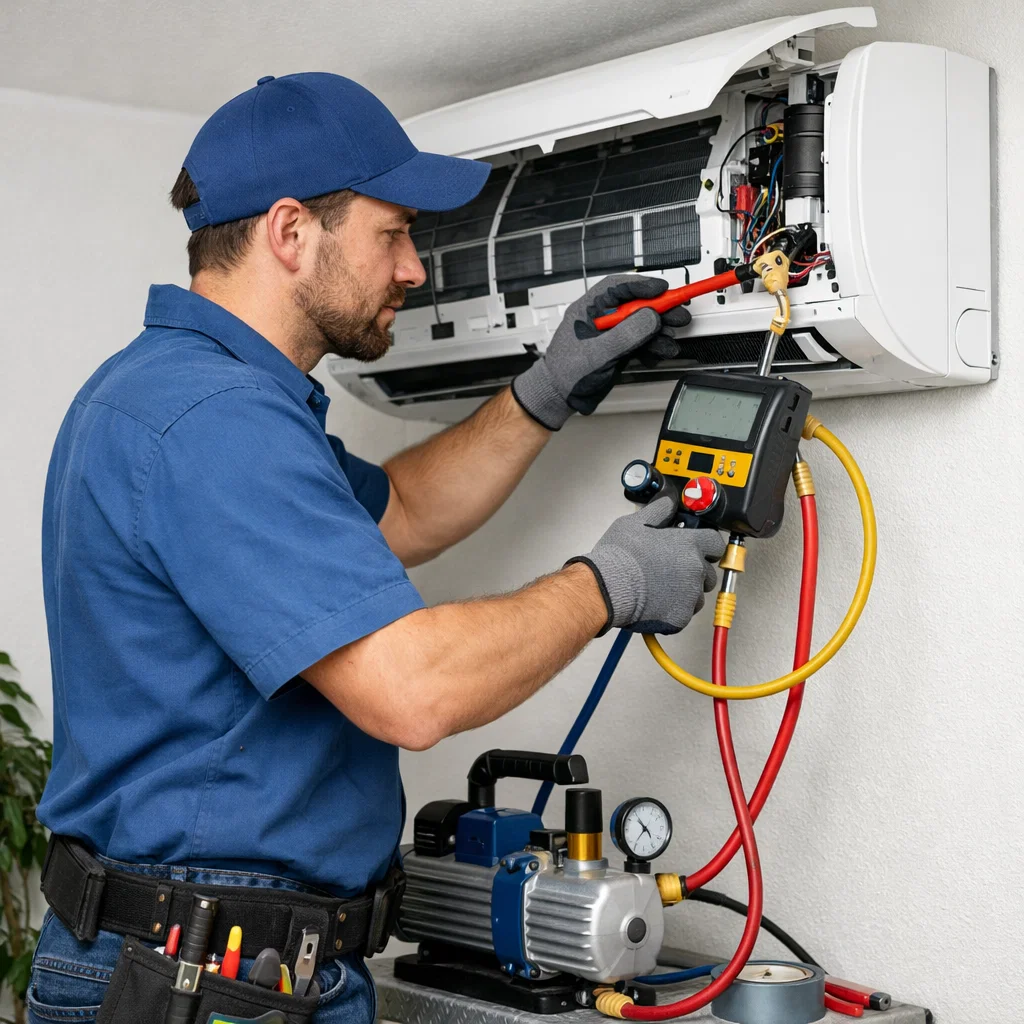
Fast, dependable AC repair in Hialeah for homes across Miami-Dade County. Our licensed technicians diagnose and fix all AC problems — from refrigerant leaks and frozen coils to electrical failures and thermostat issues — same day.
What's Actually Wrong: Common AC Repairs We Make in Hialeah
AC Running But Not Cooling
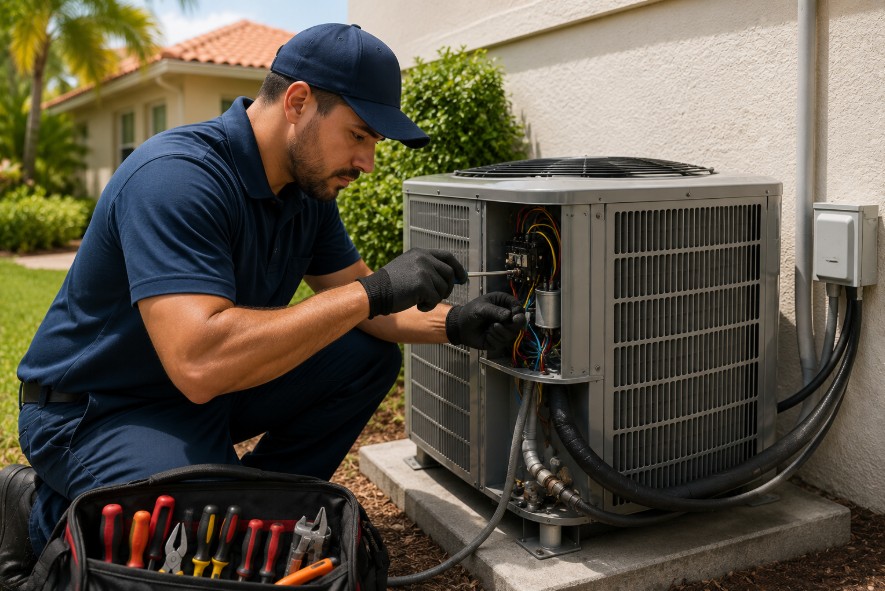
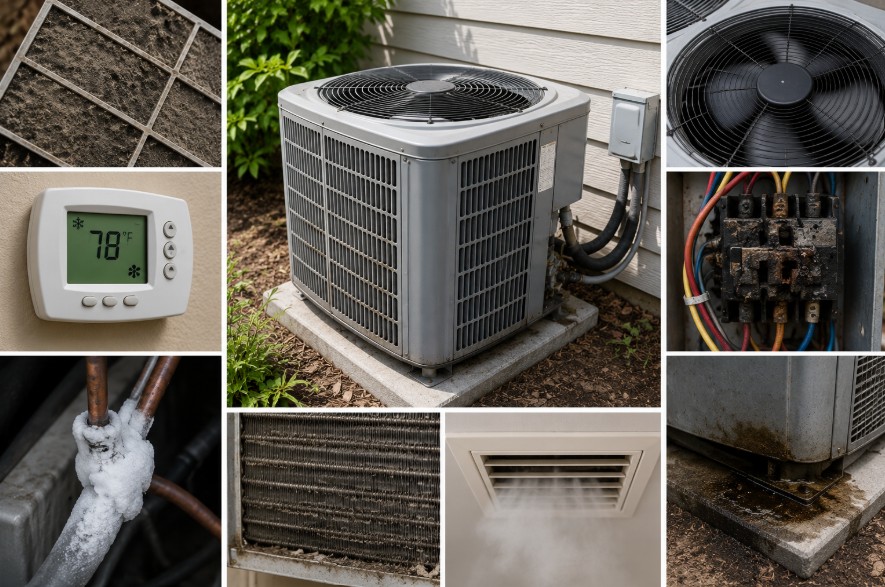
This is the single most common call we get. The unit runs, the thermostat says it's working, but the house never gets to temperature. Nine times out of ten it's one of four things: refrigerant has leaked out and there's not enough left to absorb heat properly, the evaporator coil is caked in dust and can't transfer heat, the filter is restricting airflow so hard the coil starts to freeze, or the compressor itself is wearing out and can't build enough pressure. We check refrigerant pressures against the manufacturer's target (superheat and subcooling, not just "is there gas in it") before touching anything else — adding refrigerant to a system that's actually got a dirty coil doesn't fix anything, it just masks the real problem for a few weeks.
High Indoor Humidity Despite the AC Running
If the thermostat reads 72°F but the house still feels sticky, the system is cooling the air without properly dehumidifying it. In South Florida this is usually because the system is oversized for the space (it satisfies the thermostat too fast to run a full dehumidification cycle), airflow across the coil is too high, or the system needs a refrigerant charge adjustment. We measure actual relative humidity, not just guess — a system that's technically "working" can still be leaving your house at 65% humidity when it should be closer to 50%.
Clogged Condensate Drain Line
Hialeah's humidity means your AC is pulling gallons of water out of the air every day, and all of it has to leave through a small PVC line that algae loves. When it clogs, water backs up — sometimes into a drain pan, sometimes onto your ceiling. Florida code requires a secondary drain pan with a float switch on air handlers installed in attics for exactly this reason; if yours doesn't have one, or the float switch has failed, we'll flag it.
Frozen Evaporator Coils
Ice on the indoor coil means airflow across it has dropped below what the system needs — usually a dirty filter, a failing blower motor, or low refrigerant charge letting the coil run too cold. Running a frozen system doesn't just fail to cool your house, it can flood the compressor with liquid refrigerant and shorten its life. If you see ice, shut the system off (fan-only is fine) and call us rather than letting it run.
Mold in Ductwork or on Coils
Warm, wet Hialeah air moving through cooler ductwork creates exactly the conditions mold needs, especially in older homes with duct runs through humid attics. A musty smell when the system starts, or visible dark spotting around a vent, are the first signs. We inspect the coil and accessible duct sections and can recommend a duct cleaning or coil treatment rather than just masking the smell.
Short Cycling
The system turns on, runs for a few minutes, shuts off, and repeats — never completing a full cooling cycle. This is hardest on the compressor, which draws the most current at startup. Causes range from a mis-calibrated thermostat, to a system that was oversized when it was installed, to the unit overheating and tripping its own safety switch.
Sweating Ducts and Ceiling Stains
In humid climates, ductwork that isn't insulated well enough will condense moisture on the outside of the duct, not just leak from a clog inside it. If you're seeing a wet spot on drywall that doesn't line up with a vent, this is often the actual cause — and it gets misdiagnosed as a roof leak more often than you'd think.
Refrigerant Leaks
Weak cooling, a hissing sound near the indoor or outdoor unit, ice on the lines, or cooling cycles that run longer than they used to. What it costs to fix depends heavily on what refrigerant your system uses. If you've got an older R-22 system, refrigerant alone can run $50–$100+ per pound because it hasn't been manufactured since 2020 — at that point, we'll usually walk you through whether a leak repair still makes financial sense versus replacing the system. Most systems installed in the last decade use R-410A, which is still fully legal to service and reasonably priced, though it's being phased down in new equipment as of 2025 in favor of R-454B and R-32.
Compressor Failures
The compressor is the heart of the system and the most expensive part to replace. Warm airflow, loud grinding or clunking from the outdoor unit, a tripped breaker that won't reset, or the unit humming without starting are the warning signs. Because Hialeah systems run nearly year-round, compressors here see more total run-hours than the same equipment would in a seasonal climate — it's the main reason compressor failure shows up earlier here than the national average.
AC Making Noise
Grinding usually means a bearing or motor mount. Buzzing is often electrical — a failing capacitor or contactor. Rattling is frequently just a loose panel or debris in the outdoor unit. Screeching almost always means a blower or fan motor bearing is going. We don't guess from a phone description — every noise call gets a hands-on inspection before we recommend a part.
Thermostat and Smart Thermostat Problems
Uneven temperatures room to room, a system that won't respond to schedule changes, or a smart thermostat that's lost connection to the equipment. Sometimes it's the thermostat itself; sometimes the thermostat is reporting a real problem elsewhere in the system correctly, and the fix is upstream of it. If you're running a ductless mini-split system instead of central air, the diagnosis process is different — see our mini-split repair page for that.
Why AC Systems Wear Out Faster in Hialeah
Year-round run time.
Most of the country gets a real off-season. Hialeah's system might get a break for a few weeks in January — everything else is full-time duty on compressors, blower motors, and electrical components that were designed for intermittent use.
Humidity load.
South Florida's air conditioners are doing two jobs — cooling and dehumidifying — almost every hour they run. That extra load on the coil and drain system is the direct cause of most of the "common repairs" listed above.
Home age and ductwork.
A lot of Hialeah's housing stock predates modern duct design standards. Original ductwork sized for an older, less efficient system often can't move enough air for a modern high-efficiency replacement without some rework — something worth knowing before a replacement, not after.
Storm season and salt exposure.
Heavy summer storms and coastal humidity add wear to outdoor electrical components across South Florida. The upside for Hialeah specifically: because it's inland rather than right on the coast, equipment here typically holds up longer than systems in Miami Beach, Brickell, or Key Biscayne — inland Miami-Dade systems commonly reach 15–18 years versus 10–13 years in the most coastal neighborhoods. Good to know if a company is telling you a 9-year-old system in Hialeah is automatically due for replacement — it may not be.
Our Diagnostic Process
We're not paid more for finding more problems, so we don't start guessing at parts. Here's what an actual visit looks like:
Full system inspection
Indoor and outdoor units, electrical connections, thermostat operation, and a visual check of the ductwork we can access.
Instrument-based diagnosis
Refrigerant pressures checked against manufacturer superheat/subcooling targets, capacitor tested against its rated microfarads, blower motor amp draw checked against nameplate rating, and static pressure tested if airflow is the complaint.
Clear explanation
What we found, what's causing it, what the repair options are, and what each one costs — including whether it's worth repairing at all versus starting to plan for replacement.
The repair
Using parts rated for the equipment. No universal capacitors sized "close enough" — matched to your system's actual specs.
Full performance test
Airflow, temperature split across the coil, refrigerant pressures, and thermostat response, so you're not calling us back next week for the same problem.
Permits and Code — What Actually Requires One
- Component repairs — a capacitor, contactor, blower motor, or thermostat swap — generally don't require a permit.
- Full system or condenser replacement does require a Miami-Dade mechanical permit. Because Hialeah sits in the High-Velocity Hurricane Zone, the new outdoor unit has to be installed with engineered hurricane tie-down hardware and documented product approval (NOA) — not just set on a slab and connected.
- Any licensed contractor doing that work here should be pulling that permit as a matter of course, not treating it as optional. If a company offers to skip it to save time, that's a red flag, not a favor — it can create real problems at resale.
Repair or Replace?
Sometimes the honest answer is "repair it, it's not worth replacing yet." Sometimes it's the opposite. A few things that actually move that decision, beyond just the system's age:
What refrigerant it uses
An R-22 system with a leak is a different financial conversation than an R-410A system with the same leak, simply because of what the refrigerant itself costs today.
Recent repair history
How many repairs you've had in the last two years matters. One repair is normal wear. Three in two years is usually a sign the system is failing broadly, not bad luck.
Actual electric bills
Not just "it feels expensive." A 12–15 year old system can easily be costing 30–40% more to run than a current SEER2-rated replacement.
Qualifying rebates
FPL currently offers a $200 instant rebate on qualifying replacements (SEER2 15.2 or higher) installed through an FPL-approved contractor — worth factoring into the math.
AC Repair Cost in Hialeah, FL
| AC Repair Service | Estimated Cost Range | Notes |
|---|---|---|
| Diagnostic visit | $90 – $250 | Often waived if you move forward with the repair |
| Capacitor replacement | $150 – $450 | The most common repair we do in South Florida |
| Condensate drain line service | $150 – $500 | Very common given local humidity |
| Frozen coil repair | $200 – $850 | Cost depends on root cause, not just the ice itself |
| Thermostat repair/replacement | $150 – $600 | Smart thermostats cost more to replace |
| Refrigerant leak repair (R-410A) | $250 – $1,200+ | Depends on leak location |
| Refrigerant leak repair (R-22) | $600 – $1,800+ | Refrigerant cost alone can exceed $50–$100/lb |
| Compressor repair | $600 – $2,000+ | At this point, ask us for a repair-vs-replace comparison |
| Full system replacement | $6,500 – $13,500+ | Includes Miami-Dade mechanical permit and HVHZ tie-down; FPL rebate may apply |
Scheduled Repair or Emergency? How to Tell
Book a standard repair visit if:
- The AC is cooling, just not as well as it should
- You're noticing early warning signs but the house is still livable
- It's a maintenance or efficiency concern, not a comfort emergency
- You want to schedule around your day rather than needing someone immediately
Call the emergency line instead if:
- The system has stopped cooling entirely and it's actively hot in the house
- You smell burning or anything electrical
- Water is actively leaking, not just staining
- It's happening overnight, on a weekend, or you have a health-vulnerable person in the home
Emergency AC Repair in Hialeah
Same team, faster dispatch, available 24/7
Preventing Future Repairs
Schedule a seasonal check-up. Ideally in spring, before the system runs flat-out for eight straight months.
Replace filters on a real schedule, not "whenever I remember." Every 1–3 months depending on pets and how often the house is closed up. A dirty filter is behind a huge share of the "frozen coil" and "running but not cooling" calls we run.
Flush the condensate line before rainy season. A few minutes of prevention in April beats a ceiling stain in July.
Have your attic secondary drain pan and float switch checked if your air handler is up there — it's required by code for a reason, and it's the last line of defense between a clog and real water damage.
Watch your humidity, not just your thermostat. If the house feels sticky at the set temperature, that's worth a call before it becomes a bigger issue.