

Emergency AC Repair in Hialeah, FL
When an air conditioner quits in Hialeah, the house starts gaining heat within the hour, and on a July afternoon that stops being a comfort problem fast. Our emergency AC repair team in Hialeah answers around the clock, every day of the year: 2 a.m. on a Sunday, Nochebuena, the night FPL brings the power back after a storm. We walk you through a few quick checks on the phone, send a technician the same day, and arrive with a truck stocked for the parts that cause most local breakdowns, so the repair gets done on the first visit.
What Counts as an AC Emergency in Hialeah
An AC emergency is any failure that leaves your home unable to cool while it's hot outside, or any failure that is creating a safety or water-damage risk right now. Anything else can usually wait for a regular appointment at a regular rate, and we'll tell you so when you call.
| What's happening | Call now? | Why it can't wait |
|---|---|---|
| No cooling at all, or warm air from the vents, between May and October |
Yes
|
Concrete-block homes soak up heat all day and release it all night. Miami-Dade reports heat deaths start rising at a heat index of 86°F. |
| Burning or electrical smell, smoke, sparks, loud buzzing at the outdoor disconnect |
Yes
Shut the system off at the thermostat and breaker first.
|
An electrical fault can spread to wiring and other equipment. |
| Breaker trips again right after you reset it |
Yes
|
Usually a shorted part or grounded compressor. Repeated resets make it worse. |
| Water coming through a ceiling or spreading across the floor |
Yes
|
Air handlers in attics and hall closets sit over drywall and flooring that soak up water quickly. |
| Ice on the copper lines or indoor coil |
Yes
Switch to fan-only while you wait.
|
Running an iced system can push liquid refrigerant into the compressor. |
| Outdoor unit stood in floodwater |
Yes
Leave it off.
|
Water in the electrical compartment can short the board and compressor on startup. |
| AC is out and someone at home is 65+, an infant, pregnant, or has heart or lung disease |
Yes
Tell us when you call.
|
Heat hits these groups first; we move those calls up the dispatch list. |
| A restaurant, pharmacy, clinic, server room or store loses cooling |
Yes
|
Inventory, equipment and customers can't wait for Monday. |
| AC runs but cools a bit less than it used to | Usually not | Book a scheduled AC repair in Hialeah instead. |
| Musty smell, small old stain, new noise but still cooling | Usually not | Worth fixing soon, not worth an after-hours rate. |
Three checks that solve a surprising number of calls
-
1
Thermostat. Confirm it's on Cool, set below room temperature, and the screen isn't blank. A dead battery or a tripped smart-thermostat schedule looks exactly like a dead AC.
-
2
Breakers. Check both the indoor air handler breaker and the outdoor disconnect. Reset a tripped breaker once. If it trips again, leave it off and call.
-
3
Drain safety switch. Most systems here have a float switch on the drain line or in the pan that shuts the AC off when water backs up. If the pan is full, the AC isn't broken; the drain is clogged. Don't bypass the switch. Call us and we'll clear the line.
Why ACs Break Down Suddenly in Hialeah
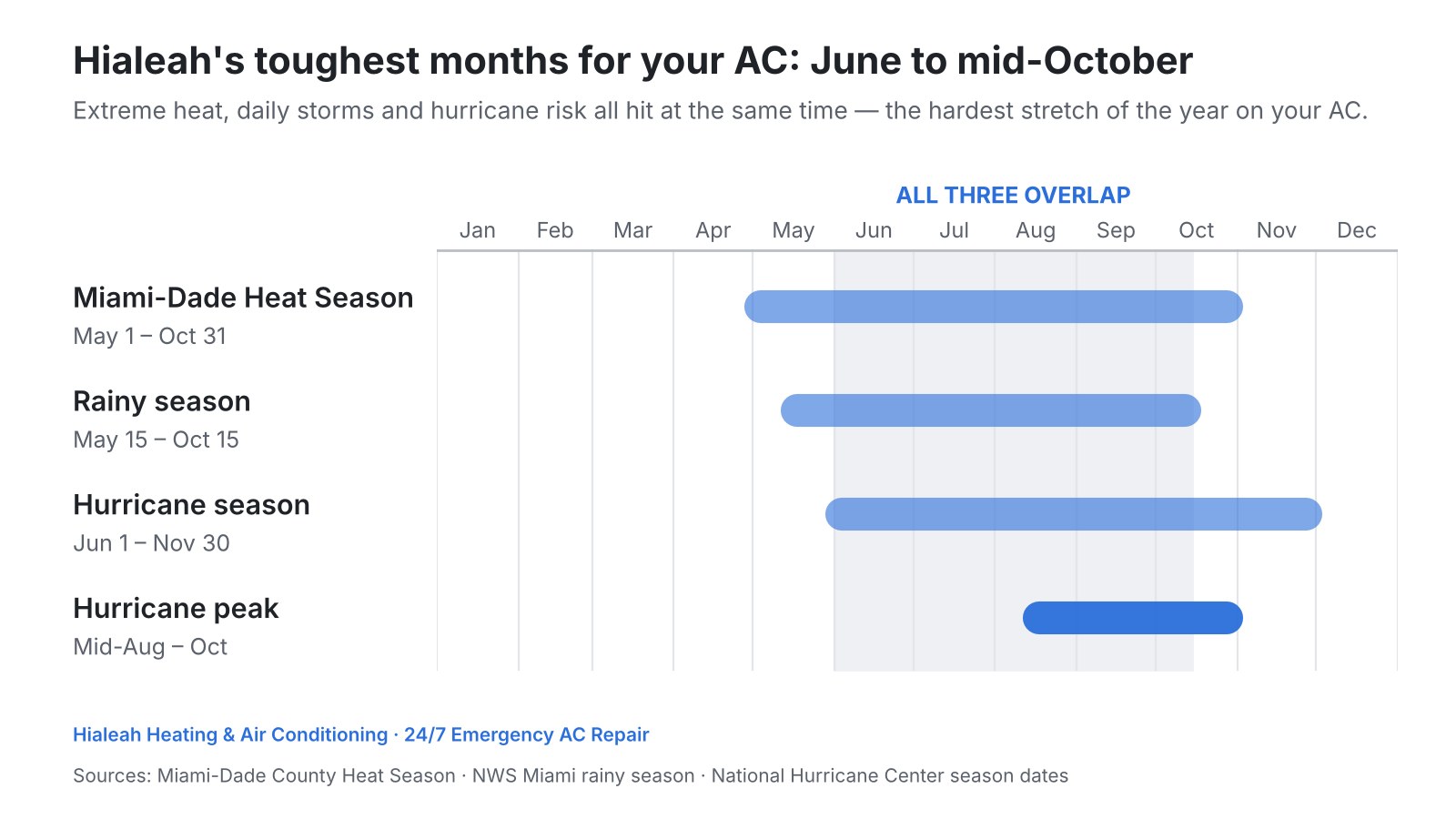
Most emergency calls we run in Hialeah trace back to five local conditions, and from May through October they stack on top of each other. Knowing which one hit your system usually tells us what failed before we open the panel.
Heat that barely lets up, even at night
Miami-Dade now averages about 133 days a year above 90°F, up from 84 in 1970, according to the county. In summer 2025, Miami International Airport, just south of Hialeah, logged 70 days at or above 90°F against a normal of 64. July 2026 brought a near-unbroken run of heat advisories, with heat index readings of 105 to 110°F on many afternoons.
The nights matter as much as the days. Miami's overnight lows have climbed nearly 3°F since the 1990s, and University of Miami data shows the number of nights that never drop below 80°F has doubled this decade compared with the 2000s. When it's still 82°F at midnight, the compressor never gets a real rest.
That constant run time is hard on the electrical parts in the outdoor unit. A run capacitor that limped through spring often gives out at 4 p.m. on the hottest day in July. Contactor points pit and burn from thousands of extra cycles. These are the most common emergency repairs we make, and they're exactly the parts our trucks carry.
Rainy season overloads the drain side
South Florida's wet season runs from May 15 to October 15 and brings about 70% of the year's rain. In air this humid, your AC pulls gallons of water out of the house every day, and all of it leaves through a thin PVC drain line that algae loves. When that line clogs, the float switch shuts the whole system off, or the pan overflows into a ceiling.
The same storms flood streets. The National Weather Service named Hialeah in flash flood warnings on July 22, 2025 (2 to 3 inches of rain) and June 3, 2026 (4 to 5 inches in northern Miami-Dade). Condensers sitting on low slabs can end up standing in water. In April 2026 the city received $4.9 million in federal funding for stormwater work in Southeast Hialeah, a sign of how often those blocks flood.
Lightning and unstable power
The Miami–Fort Lauderdale area recorded more lightning than any other U.S. metro in 2023: 120,998 flashes, according to Vaisala's annual report. A strike doesn't have to hit your house. A surge on the line can take out a control board, a capacitor, a thermostat transformer or the compressor windings. Power that flickers, or comes back in stages after an outage, makes the compressor try to start on low voltage, which is when a weak part finally fails.
If your AC died right when the lights came back, tell us. That narrows the diagnosis to a handful of parts. FPL Home's SurgeShield program puts a surge protector at the meter that helps against indirect strikes; it doesn't stop a direct hit.
Hurricane season brings outages and debris
The Atlantic hurricane season runs June 1 to November 30, with the peak from mid-August through October. Forecasters expected a below-normal 2026 season, but a single tropical storm can still knock out power for days, throw debris into a condenser, bend coil fins or loosen the hurricane tie-downs that hold an outdoor unit in place. After any storm, have the outdoor unit looked at before you run it hard.
Older homes, older electrical systems
The median Hialeah home was built in 1975, and more than half of the city's housing went up between 1950 and 1979. Many of these concrete-block houses were built before central air was standard. Air handlers ended up in hall closets, garages and attics, ductwork was added later, and some homes now run two or three systems from different decades. Original panels and wiring weren't sized for today's equipment, so loose connections and overheated breakers show up more often here than in newer suburbs.
About 53% of Hialeah homes are rented, many in duplexes and garden apartments where one condensing unit sits next to five others and airflow around it is tight. That adds heat to the condenser on exactly the days it can least afford it.
What to Do While You Wait for Your Technician
A few minutes of the right steps protects both your family and the equipment, and often shortens the repair.
Smell burning or see sparks? Turn the thermostat off, then switch off the air handler breaker and the outdoor disconnect. Keep everyone away from the unit.
Ice on the lines or coil? Set the thermostat to Off and the fan to On. The fan thaws the coil faster, and we can't diagnose a frozen system until it melts.
Water coming through? Turn the system off, put a bucket and towels under the leak, and move furniture and electronics. If you can reach the drain pan safely, a wet-dry vacuum keeps it from spilling over.
Unit flooded after a storm? Leave it off until we've checked it, even if the water has drained.
Power just came back? Leave the AC off for a few minutes until the power is steady, then try it once.
Keep the heat out. Close blinds on the east and west sides, shut doors to unused rooms, and keep everyone in the coolest room with fans running. Skip the oven and dryer until we're done.
Clear the way. Unlock the side gate, put pets inside, and clear a path to the air handler closet or attic hatch.
How Our 24/7 AC Repair in Hialeah Works
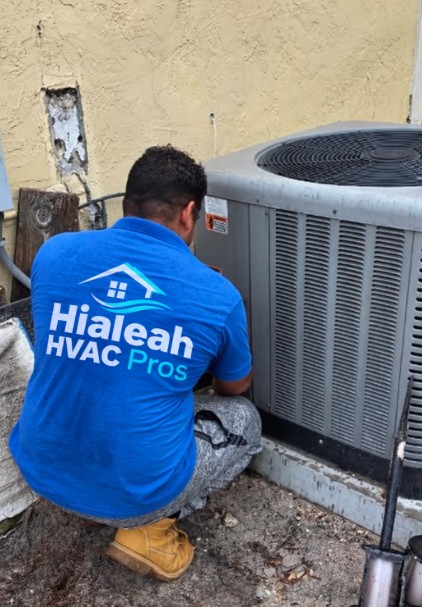
Our 24/7 AC repair in Hialeah runs the same way at 3 p.m. or 3 a.m., with the same technicians and the same pricing rules.
You call and a person answers, in English or Spanish. [Confirm live answering 24/7.] We ask what the system is doing, what you've already checked, your address, and who's at home.
We triage on the phone. If it's a tripped breaker or a full drain pan, we'll talk you through it and you may not need a visit at all. If it's a real failure, we tell you so.
We dispatch by urgency. A dead system in a home with an elderly resident or a baby goes ahead of a unit that's cooling poorly. You get a time window and a text when the technician is on the way.
We diagnose with meters, not guesses. Power and safety switches first, then capacitor readings, amp draw, refrigerant pressures and drain flow. You see what we find.
You approve a flat price before we start. No work begins until you've agreed to the number.
We fix it on that visit. The truck carries the parts behind most Hialeah emergencies, listed in the next section.
We prove it's working before we leave. We check the temperature drop across the coil, airflow and drain flow, and make sure the house is actually cooling down.
Emergency Breakdowns We Fix on the First Visit
We fix emergency breakdowns on the first visit because we stock for the failures Hialeah's heat, storms and humidity actually cause. These are the ones we see most.
| Failure | What you notice | First-visit fix |
|---|---|---|
| Failed run or start capacitor | Outdoor fan or compressor hums but won't start, or starts and quits | Test and replace with a capacitor matched to the unit's rating |
| Burnt or pitted contactor | Outdoor unit won't come on, or won't shut off | Replace the contactor and check the wiring it heated |
| Clogged drain line, tripped float switch | AC shut off for no clear reason, full pan, water at the closet or ceiling | Clear and flush the line, reset the switch, confirm drainage |
| Condenser fan motor out | Outdoor fan not turning, compressor running hot and tripping | Replace the motor and capacitor, check the blade |
| Surge-damaged control board or blown low-voltage fuse | Dead system after lightning or a power flicker | Trace the fault, replace the fuse or board, look for the cause |
| Frozen evaporator coil | Ice on lines, little or no airflow | Thaw, then find the cause: airflow, blower or refrigerant |
| Burnt wiring at the disconnect or breaker | Burning smell, scorched lugs, breaker trips | Replace damaged wire, disconnect or breaker |
| Blower motor failure | Outdoor unit runs, no air from vents | Replace the motor or its capacitor |
| Thermostat or wiring fault | Blank screen, no call for cooling | Repair wiring or replace the thermostat |
| Small accessible refrigerant leak | Weak cooling, hissing, oily spot at a fitting | Repair the leak, evacuate and recharge to spec |
When one visit can't finish the job
A failed compressor or a cracked coil sometimes means replacing equipment, and we'd rather tell you that straight than sell you a repair that won't hold. Florida's Building Code (section 105.2.1) lets a licensed contractor replace equipment in an emergency and file the permit with the building official by the next business day, so you aren't left waiting on paperwork. In Hialeah, that permit goes through the City of Hialeah Building Department, and the new outdoor unit must be anchored to hurricane-zone standards.
Refrigerant matters too. New equipment built since 2025 uses lower-impact refrigerants such as R-454B and R-32, while pre-2025 R-410A equipment can still be installed under a 2026 EPA rule. Which one fits your house affects what we can install the same day. If replacement is the better call, our AC replacement team takes it from there.
Staying Safe in the Heat Until Cooling Is Back
Heat is the leading weather-related killer in the U.S., and Miami-Dade estimates about 600 excess deaths a year in the county during periods of extreme heat. The county runs a Heat Season from May 1 to October 31 for exactly that reason.
Hialeah's population makes this personal. Roughly one in five residents is 65 or older, a group that feels heat sooner and shows it later. If the AC is out, check on older family members and neighbors, especially anyone living alone.
Heavy sweating, cool clammy skin, dizziness, nausea, headache, weakness. Move the person to the coolest spot, loosen clothing, sip water, and use cool cloths.
High body temperature, hot red skin, confusion, slurred speech, fainting or seizure: call 911 first, then us.
While you wait:
- Keep everyone in one shaded room with fans and plenty of water.
- Put pets indoors in the coolest room with water; don't leave them on a porch or in a car.
- If the house won't cool and we're hours away, go somewhere air-conditioned. During heat advisories the county lists cooling sites at miamidade.gov/heat.
- NWS Miami issues a Heat Advisory for Miami-Dade when the heat index reaches 105°F for two hours, and an Extreme Heat Warning at 110°F. On those days, tell us when you call.
What Emergency AC Repair Costs in Hialeah
Emergency service costs the same as a regular visit. There's no after-hours fee, no weekend or holiday surcharge and no diagnostic fee; you pay only for the repair you approve. Here's how it works:
No after-hours, weekend or holiday surcharge. A 2 a.m. call on a holiday is priced the same as a Tuesday afternoon.
No diagnostic fee. Finding the problem is on us, day or night.
Free phone triage. If a breaker reset or drain clear over the phone fixes it, you owe nothing.
Flat repair price, agreed before work starts. The price depends on the part and labor, never the hour.
No surprise add-ons. If we find a second problem, we explain it and you decide whether to fix it now or later.
Where We Respond in Hialeah

Our dispatch base on West 4th Avenue puts most Hialeah addresses a short drive away by Palm Avenue, West 49th Street, Okeechobee Road or the Palmetto Expressway.
| ZIP | Areas we cover |
|---|---|
| 33010 | Central Hialeah near City Hall, Seminola, Hialeah Acres |
| 33012 | West 4th Avenue and West 49th Street corridor, Westland area, Palm Springs |
| 33013 | East Hialeah, Hialeah Park and Amelia Earhart Park area |
| 33014 | North Hialeah |
| 33015 | North and northwest Hialeah |
| 33016 | West Hialeah |
| 33018 | Far west Hialeah along Okeechobee Road toward the Turnpike |
We also take emergency calls in Hialeah Gardens, Miami Lakes, Medley, Miami Springs, Palm Springs North and Country Club.
Much of 33010 and 33013 is 1950s concrete-block housing with closet air handlers and add-on ductwork, while 33018 has more newer townhomes and condos. We plan the truck stock around both.